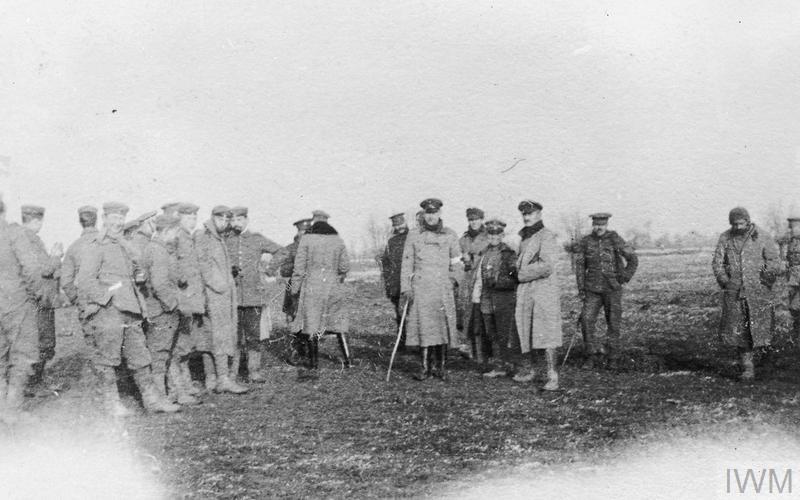
Can you imagine that during World War I, on Christmas 1914, British and German soldiers left their trenches and gathered at the No Man’s land to exchanged gifts, took photographs, and played games? If this wasn’t recorded by photographs, I would never believe such a story…
Several years ago, I randomly encountered and downloaded a game called The Evolution of Trust on my Android phone. It is an interactive game that explains the basics of game theory and the mechanism of trust in our society. As a dumb kid, I didn’t know what is a game theory, nor did I even heard of it before. However, I was amazed by its interactive design, descriptive representation of an abstract/mathematical phenomenon, and cool cartoon art style that this game encompasses. I played it over and over again to see the result of interactions between different characters, and this game was engraved in a forbidden area of my brain.
Years later, as a first-year college student, I took the microeconomic course in USC taught by Professor Alejandro Martinez-Marquina. In one class activity about “guess 2/3 of the average” in game theory, I suddenly thought of my childhood obsession of the game The Evolution of Trust. “Hmmmm, this back-and-forward game between individual and collective intelligence… sounds a bit like the Law of Dark Forest from the Three Body Problem. Two players unaware of each other’s strategy, and A needs to incorporate B’s strategy (which also includes A’s strategy (which includes B’s strategy (which …)) to make the optimal decision. Wait. Didn’t I played a game similar to this one?” There, after years, I revisited the The Evolution of Trust.
The game is based on a machine that generates different pay-offs according to different choices that each player make. Two players, each can choose to “CHEAT” or “COOPERATE”, will be rewarded differently. When both player cooperate, they both get 2 tokens; when one cheat and one cooperate, the cheater gets 3 and cooperator loses 1 token; when both cheat, they all get nothing.
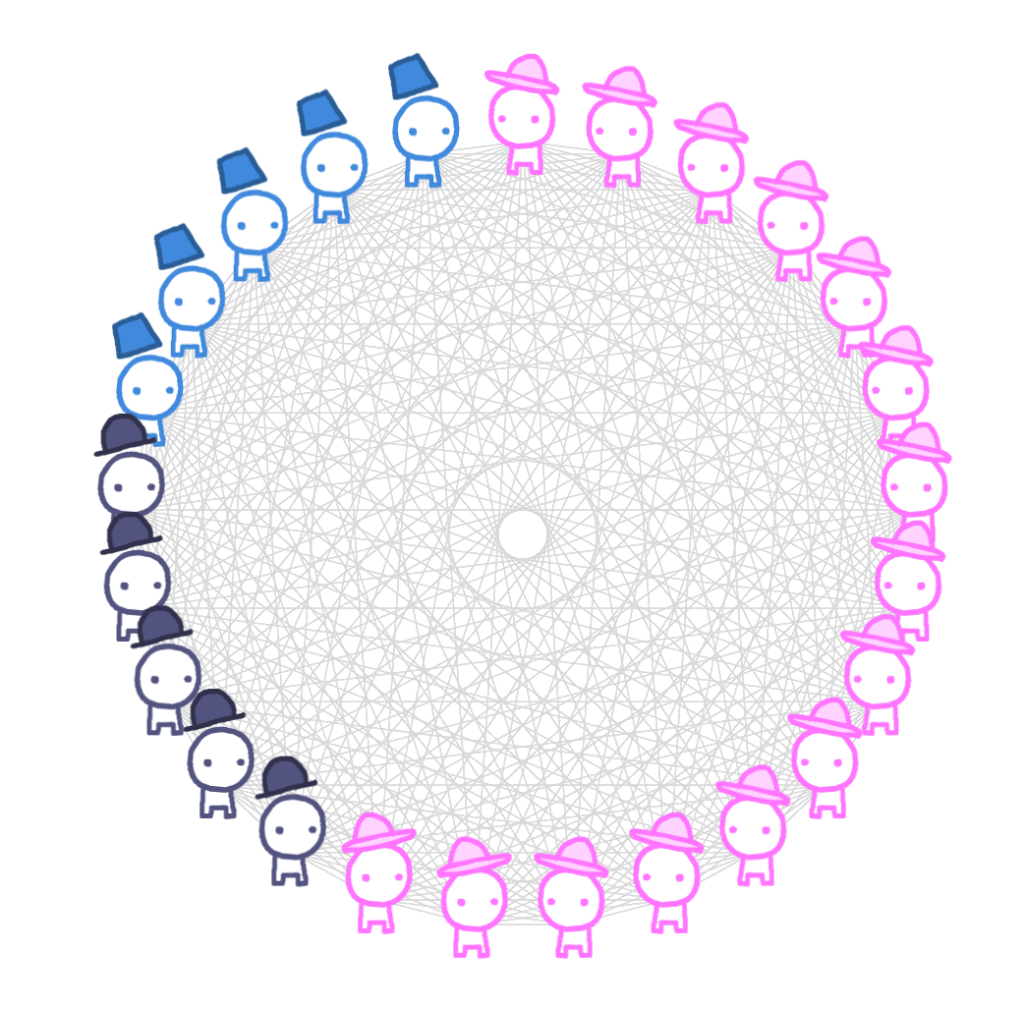
As this might seems simple, and those who have taken game theory class will know that dominant strategy/Nash equilibrium is to both choose cheat, more interesting thing comes in. The game starts introducing several characters that each possesses a unique strategy. For example, copycat, who starts with cooperation and then simply repeats what the other play does at the last round; cooperator/cheater, as their names suggest; grudger, who starts with cooperation, continues to cooperate until the other player cheats, and continues cheating afterward… In repeated trials among these characters, some strategies dominates the others. Obviously, cheater will always win over cooperator, and copycat will lose its 1 token when facing cheater, but never fall in the trap again. However, who will win if these five characters forms a society, and the tournaments are repeatedly conducted among them many rounds?

A: Idk but stop skipping MATH 407 bro
It is surprised to find out copycat is the best player to survive in such scenario! (results might vary depend of the proportion of the characters, but copycat dominates most tournament). Why? Because the repetitive behaviors of copycats ripples the benefits of all cooperation-inclined characters (including themselves, who start with cooperation) and prevents them from being taken advantages. Therefore, they are not as vulnerable as the cooperators, who are dominated by the cheaters. After all characters, except copycat and cheater, are eliminated, copycats then continues to ripple the rewards among themselves, and ultimately drive the cheaters out.This reminds me of the idea of reciprocity in behavior economics, which states that people are likely to behave in the same manner with an individual as that person has behaved with them before. Human are complex animals and our social rule is even more complex, yet this complex society is sometimes functioned under such simple rules that might be determined by our biological and genetic factors.
I’m not going to continue spoiling the game, because there are so much to explore within this thirty minutes of interactive experience. Thanks to its excellent creator Nicky Case, the game clearly demonstrated the concept of trust and the role of miscommunication, constant interaction, and social resources in building trust with unique characters (there are more characters with much complex strategies) and tournaments (which models the society in such a fun way). The game also allows you to change the parameters such as the proportion of each character, the pay-off of the machine, and the chance that each player will make a mistake (for example, each player having 5% chance of deviating from original strategy). Each tweak of parameters will have drastic effects on the final survivor in this simulate society, which is quite fun to play around with.
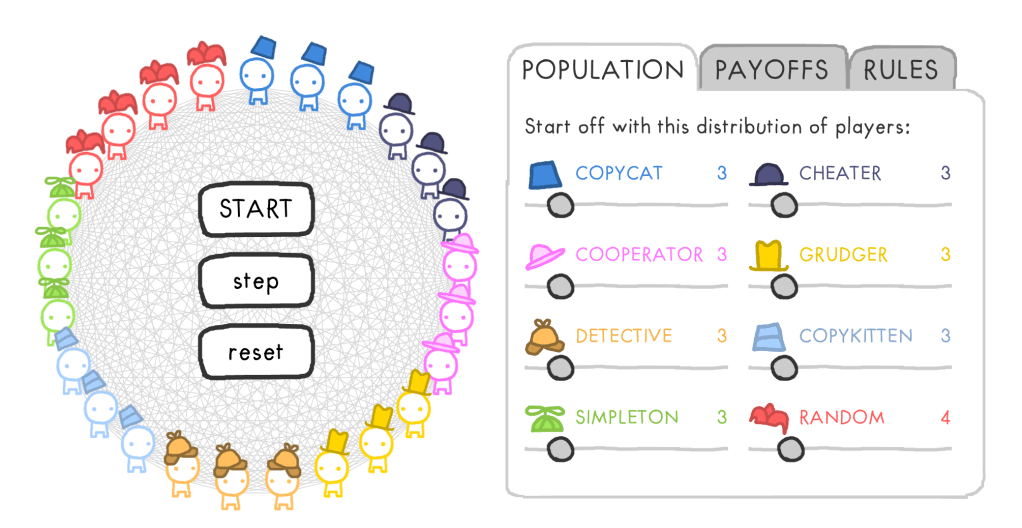
The Ultimate, Eventual Sandbox Mode!If you are interest in game theory, discrete mathematics, or simply how psychology and behavior economics affects our daily life, I would highly recommend you try out this game. Maybe one day you will have a Eureka moment, remembering the mechanism of trust that dominates every single detail in our world.
 JJLIN
JJLIN 
留下评论